https://www.forbes.com/sites/panosmourdoukoutas/2019/03/23/pakistan-beats-india-in-happiness/#7a0ed5b91378
“It must be other metrics, like income inequality and poverty,” says Udayan Roy, Professor of Economics at LIU POST. “That’s matters more than per capita GDP when it comes to well-being of the masses.”
Indeed, the rich are getting richer in India while the poor are getting poorer.
Over the last four decades, India’s top 1% earners’ share of the country’s income rose from roughly 7% to 22%, as of 2014. Meanwhile, the income share of the bottom 50% earners declined from roughly 23% in the early 1980s to 15% in 2014.
That’s according to 2018 World Inequality Report, which compiles data from the 1950s to 2014.
Meanwhile, India’s income inequality is much higher than that of both Pakistan, and Bangladesh, as measured by the Gini coefficient of income inequality.
That’s according to Standardized World Income Inequality data.
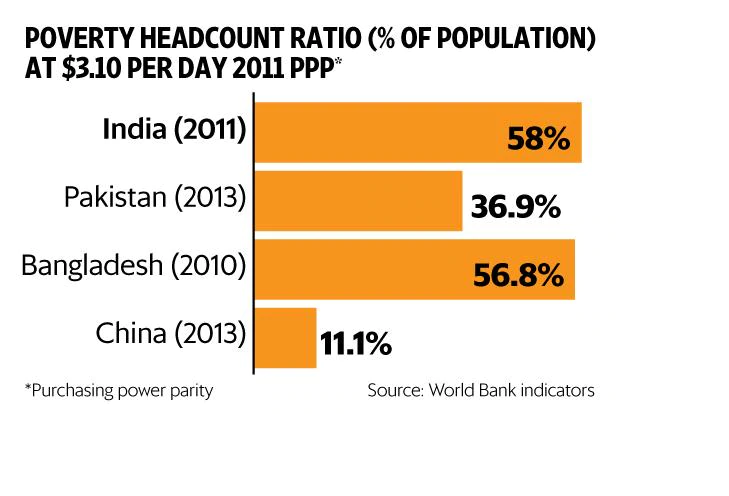
Meanwhile, poverty rates are higher in India than they are in Pakistan and Bangladesh, according to World Bank.
Then there’s “vulnerable employment”— employment in unpaid family activities—which is much higher in India than in Pakistan and Bangladesh.
Wait, there’s more. There’s economic freedom.
Published by the Heritage Foundation, the Economic Freedom report measures such things as trade freedom, business freedom, investment freedom, and the degree of property rights protection in 186 countries.
Though the two countries have ranked closely in the last couple of years, Pakistan’s ranking has consistently beaten India's over longer periods.
In fact, a closer look at the ranking components of the two countries reveals that Pakistan has fared better than India in the area of government spending, which matter a great deal when it comes to providing on welfare programs.
Simply put, Pakistan has been getting ahead of India in spreading the wealth to the masses.






















 Cricket
 Kyunki Saas Bhi Kabhi Bahu Thi 2
 Anupamaa


5