Celebrations around the world
India
Gujarat
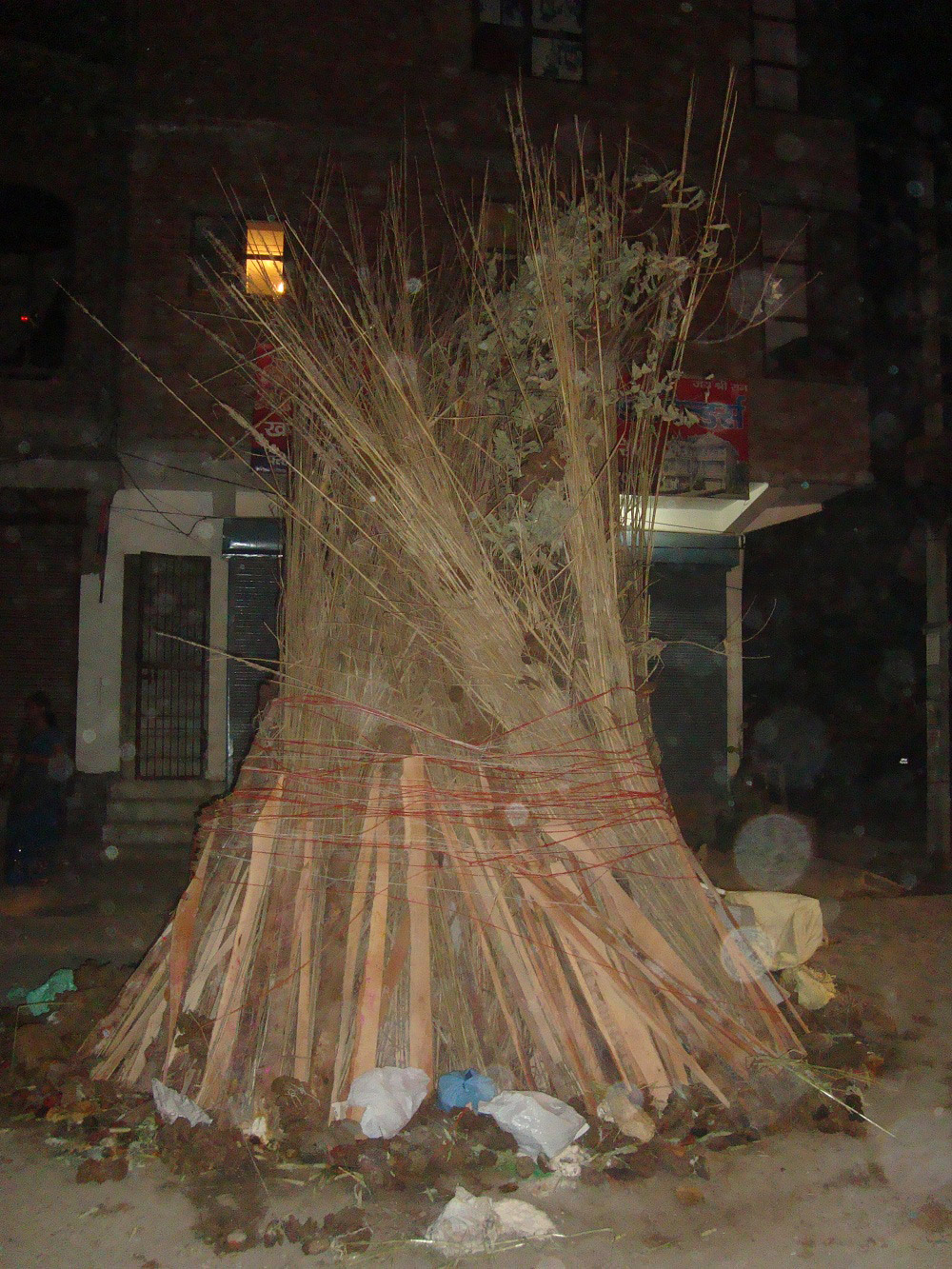
In Gujarat, Holi is a two-day festival. On the evening of the first day people light the bonfire. People offer raw coconut and corn to the fire. The second day is the festival of colour or "Dhuleti", celebrated by sprinkling coloured water and applying colours to each other. Dwarka, a coastal city of Gujarat, celebrates Holi at the Dwarkadheesh temple and with citywide comedy and music festivities.
The Holi celebration has its celebrative origins in Gujarat,[citation needed] particularly with dance, food, music, and coloured powder to offer a spring parallel of Navratri, Gujarat's Hindu festival celebrated in the fall. Falling in the Hindu month of Phalguna, Holi marks the agricultural season of the rabi crop.
In Ahmedabad in Gujarat, in western India, a pot of buttermilk is hung high over the streets and young boys try to reach it and break it by making human pyramids. The girls try to stop them by throwing coloured water on them to commemorate the pranks of Krishna and the cowherd boys to steal butter and "gopis" while trying to stop the girls. The boy who finally manages to break the pot is crowned the Holi King. Afterwards, the men, who are now very colourful, go out in a large procession to "alert" people of Krishna's possible appearance to steal butter from their homes.
In some places there is a custom in undivided Hindu families that the woman beats her brother-in-law with a sari rolled up into a rope in a mock rage and tries to drench him with colours, and in turn, the brother-in-law brings sweets (Indian desserts) to her in the evening.
Uttar Pradesh
Barsana, a town near Mathura in the Braj region of Uttar Pradesh, celebrates Lath mar Holi in the sprawling compound of the Radha Rani temple. Thousands gather to witness the Lath Mar Holi when women beat up men with sticks as those on the sidelines become hysterical, sing Holi songs and shout "Sri Radhey" or "Sri Krishna". The Holi songs of Braj mandal are sung in pure Braj, the local language. Holi celebrated at Barsana is unique in the sense that here women chase men away with sticks. Males also sing provocative songs in a bid to invite the attention of women. Women then go on the offensive and use long staves called lathis to beat the men, who protect themselves with shields.
Mathura, in the Braj region, is the birthplace of Lord Krishna. In Vrindavan this day is celebrated with special puja and the traditional custom of worshipping Lord Krishna; here the festival lasts for sixteen days. All over the Braj region and neighboring places like Hathras, Aligarh, and Agra, Holi is celebrated in more or less the same way as in Mathura, Vrindavan and Barsana.
Outside Braj, in the Kanpur area, Holi lasts seven days with colour. On the last day, a grand fair called Ganga Mela or the Holi Mela is celebrated. This Mela (fair) was started by freedom fighters who fought British rule in the First Indian War of Independence in 1857 under the leadership of Nana Saheb. The Mela is held at various ghats along the banks of the River Ganga in Kanpur, to celebrate the Hindus and Muslims who together resisted the British forces in the city in 1857. On the eve of Ganga Mela, all Government offices, shops, Courts generally remain closed. The Ganga Mela marks the official end of "The Festival of Colours" or Holi in Kanpur.
In Gorakhpur, the northeast district of Uttar Pradesh, this day starts with a special puja (Hinduism) in the morning of Holi day. This day is considered to be the most colourful day of the year, promoting brotherhood among the people. This is known as "Holi Milan" in which people visit every house and sing Holi songs and express their gratitude by applying coloured powder (Abeer). Holi is also considered as the beginning of the year as it occurs on the first day of the Hindu calendar year (Panchang).
Uttarakhand
Kumaoni Holi in Uttarakhand includes a musical affair. It takes different forms such as the Baithki H oli, the Khari Holi and the Mahila Holi. In Baithki Holi and Khari Holi, people sing songs with a touch of melody, fun and spiritualism. These songs are essentially based on classical ragas. Baithki Holi also known as Nirvan Ki Holi, begins from the premises of temples, where Holiyars sing Holi songs and people gather to participate, along with playing classical music. The songs are sung in a particular sequence depending on the time of day; for instance, at noon the songs are based on Peelu, Bhimpalasi and Sarang ragas, while evening songs are based on the ragas such as Kalyan, Shyamkalyan and Yaman. The Khari Holi is mostly celebrated in the rural areas of Kumaon. The songs of the Khari Holi are sung by the people, who, sporting traditional white churidar payajama and kurta, dance in groups to the tune of ethnic musical instruments such as the dhol and hurka.
In Kumaon region, the Holika pyre is known as Cheer (,) which is ceremonially made in a ceremony known as Cheer Bandhan ( ) fifteen days before Dulhendi. The Cheer is a bonfire with a green Paiya tree branch in the middle. The Cheer of every village and neighborhood is rigorously guarded as rival mohalls try to playfully steal each other's cheer.
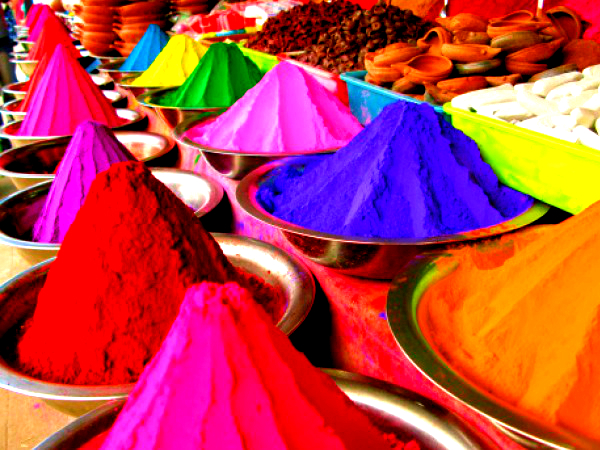
The colours used on Holi are derived from natural sources. Dulhendi, known as Charadi (from Chharad is made from flower extracts, ash and water. Holi is celebrated with great gusto much in the same way all across North India.
Bihar
Holi is known as Phaguwa in the local Bhojpuri dialect. In this region as well, the legend of Holika is prevalent. On the eve of Phalgun Poornima, people light bonfires. They put dried cow dung cakes, wood of the Araad or Redi tree and Holika tree, grains from the fresh harvest and unwanted wood leaves in the bonfire. At the time of Holika people assemble near the fire. The eldest member of the gathering or a purohit initiates the lighting. He then smears others with colour as a mark of greeting. Next day the festival is celebrated with colours and a lot of frolic. Traditionally, people also clean their houses to mark the festival.
Holi Milan is also observed in Bihar, where family members and well wishers visit each other's family, apply colours (abeer) on each other's faces, and on feet, if elderly. Usually this takes place on the evening of Holi day after Holi with wet colours is played in the morning through afternoon. Due to large scale internal migration issues faced by the people, recently this tradition has slowly begun to transform. It is common to have Holi Milan on an entirely different day either before or after the actual day of Holi.
Children and youths take extreme delight in the festival. Though the festival is usually celebrated with colours, in some places people also enjoy celebrating Holi with water solutions of mud or clay. Folk songs are sung at high pitch and people dance to the tune of dholak and the spirit of Holi. Intoxicating bhang, made from cannabis, milk and spices, is consumed with a variety of mouth-watering delicacies, such as pakoras and thandai, to enhance the mood of the festival.
Bengal
In West Bengal, Holi is known by the name of "Dol Jatra", "Dol Purnima" or the "Swing Festival". The festival is celebrated in a dignified manner by placing the icons of Krishna and Radha on a picturesquely decorated palanquin which is then taken round the main streets of the city or the village. On the Dol Purnima day in the early morning, students dress up in saffron-coloured or pure white clothes and wear garlands of fragrant flowers. They sing and dance to the accompaniment of musical instruments like ektara, dubri, veena, etc. The devotees take turns to swing them while women dance around the swing and sing devotional songs. During these activities, the men keep spraying coloured water and coloured powder, abir, at them.
The head of the family observes a fast and prays to Lord Krishna and Agnidev. After all the traditional rituals are over, he smears Krishna's icon with gulal and offers "bhog" to both Krishna and Agnidev. In Shantiniketan, Holi has a special musical flavour. Visitors on Holi are offered traditional dishes that include malpoa, kheer sandesh, basanti sandesh (saffron), saffron milk, payash, and related foods.
Odisha
The people of Odisha celebrate "Dola" on the day of Holi where the icons of Jagannath replace the icons of Krishna and Radha. Dola Melana, processions of the deities are celebrated in villages and bhoga is offered to the deities. "Dola yatra" was prevalent even before 1560 much before Holi was started where the idols of Jagannatha, Balabhadra and Subhadra used to be take to the "Dolamandapa" (podium in Jagannath temple). People used to offer natural colors known as "abira" to the deities and apply on each other's feats.
Assam
Holi, also called Phakuwa () in Assamese, is celebrated all over Assam. Locally called Dol Jatra, associated with Satras of Barpeta, Holi is celebrated over two days. On the first day, the burning of clay huts are seen in Barpeta and lower Assam which signifies the legends of Holika. On the second day of it, Holi is celebrated with colour powders. The Holi songs in chorus devoted to Lord Krishna are also sung in the regions of Barpeta.
Goa
Holi is a part of Goan or Konkani spring festival known as igmo or in Koka or iirotsava and lasts for about a month. The colour festival or Holi is a part of longer, more extensive spring festival celebrations. Holi festivities (but not igmo festivities) include: Holika Puja and Dahan, Dhulvad or Dhuli vandan, Haldune or offering yellow and saffron colour or Gulal to the deity.
Maharashtra
In Maharashtra, Holi Purnima is also celebrated as Shimga, festivities that last 5 to 7 days. A week before the festival, youngsters go around the community, collecting firewood and money. On the day of Shimga, the firewood is a huge pile in neighborhoods. In the evening, the fire is lit. Every household brings a meal and dessert, in the honour of the fire god. Puran Poli is the main delicacy and children shout "Holi re Holi puranachi poli". Shimga celebrates the elimination of all evil. The colour celebrations here traditionally take place on the day of Rangapanchami, five days after Shimga. During this festival, people are supposed to forget and forgive any rivalries and start new healthy relations with all.
Manipur
Manipuris celebrate Holi for 6 days. Here, this holiday merges with the festival of Yaosang. Traditionally, the festival commences with the burning of a thatched hut of hay and twigs. Young children go from house to house to collect money, locally known as nakadeng (or nakatheng), as gifts on the first two days. The youths at night perform a group folk dance called Thabal chongba on the full moon night of Lamta (Phalgun) along with folk songs and rhythmic beats of the indigenous drum. However, this moonlight party now has modern bands and fluorescent lamps. In Krishna temples, devotees sing devotional songs, perform dances and celebrate with aber (gulal) wearing traditional white and yellow turbans. On the last day of the festival, large processions are taken out to the main Krishna temple near Imphal where several cultural activities are held. In recent decades, Yaoshang, a type of Indian sport, has become common in many places of the valley, where people of all ages come out to participate in a number of sports that are somewhat altered for the holiday.
Kerala
Holi is locally called Ukkuli in Konkani or Manjal Kuli in Malayalam. It is celebrated around the Konkani temple called Gosripuram Thirumala temple.
Karnataka
Traditionally, in rural Karnataka children collect money and wood in the weeks prior to Holi, and on "Kamadahana" night all the wood is put together and lit. The festival is celebrated for two days. People in north Karnataka prepare special food on this day.In Sirsi, Karnataka, Holi is celebrated with a unique folk dance called "Bedara Vesha", which is performed during the nights beginning five days before the actual festival day. The festival is celebrated every alternate year in the town, which attracts a large number of tourists from different parts of the India.
Telangana
As in other parts of India, in rural Telangana region, children celebrate kamuda and collect money, rice, Mokkajonna and wood for weeks prior to Holi, and on Kamudha night all the wood is put together and set on fire.
Andhra Pradesh
In Andhra Pradesh Holi is celebrated along with Basanta Panchami. Holi is a major festival, and the festivities and colour start appearing at least a day before the actual holiday.
Jammu & Kashmir
In Jammu & Kashmir, Muslims and Hindus alike celebrate Holi. Holi celebrations here are much in line with the general definition of Holi celebrations: a high-spirited festival to mark the beginning of the harvesting of the summer crop, with the throwing of coloured water and powder and singing and dancing.
Punjab & Himachal Pradesh
In Punjab, Holi is preceded by Holika Dahan the night before. On the day of Holi, people engage in throwing colours on each other.During Holi in Punjab, walls and courtyards of rural houses are enhanced with drawings and paintings similar to rangoli in South India, mandana in Rajasthan, and rural arts in other parts of India. This art is known as chowk-poorana or chowkpurana in Punjab and is given shape by the peasant women of the state. In courtyards, this art is drawn on cloth. The art includes drawing tree motifs, flowers, ferns, creepers, plants, peacocks, palanquins, geometric patterns along with vertical, horizontal and oblique lines. These arts add to the festive atmosphere.
Madhya Pradesh
In western Madhya Pradesh, Bhil tribesmen who have held on to many of the pre-Hindu customs celebrate it in a special way.
Tamil nadu
In the Phalguna Poornima is Panguni Uthram (Meena Uttara-phalguni in Sanskrit). It is special because of the star "Uthiram" and "Pournami" occurring together, is the marriage anniversary of many mythological figures and deities. On this day Goddess Mahalakshmi incarnated on earth from the ocean of milk (after the ocean was churned by the gods and the demons). Holi is celebrated as Vasanthosavam and all temples start their Utsavams with decorations and music, dance festivals, Pravachans and Harikathas. The colours are also popular, and celebrate divine love and welcoming of spring.
Nepal
In Nepal, Holi celebrated in Hills is remarkably different from Madhesh, even the festival is celebrated on two different days. Holi is celebrated in the month of Falgun and is also called as the "Fagu/Phaguwa" and is celebrated on the full moon day (in hills) and the day after (in Madhesh) in the month of February. The word "Fagu/Phaguwa" represents the month of Falgun and the day is called the "Fagu Purnimaa" which means (full moon day in the Falgun).
In Nepal, Holi is as important as Dashain, Tihar (Dipawali). Since more than 80% of people in Nepal are Hindus, Holi, along with many other Hindu festivals, is celebrated in Nepal as a national festival.
People walk down their neighbourhoods to celebrate Holi by exchanging colours and spraying coloured water on one another. A popular activity is the throwing of water balloons at one another, sometimes called lola (meaning water balloon). Also a lot of people mix bhang in their drinks and food, as is also done during Shivaratri. It is believed that the combination of different colours at this festival take all the sorrow away and make life itself more colourful.
Indian diaspora
Over the years, Holi has become an important festival in many regions wherever Indian diaspora were either taken as indentured labourers during colonial era, or where they emigrated on their own, and are now present in large numbers such as in Africa, North America, Europe, Latin America, and parts of Asia such as Fiji.
Holi is a national holiday in Suriname. It is called Phagwa festival, and is celebrated to mark the beginning of spring and Hindu mythology. In Suriname, Holi Phagwa is a festival of colour. It is customary to wear old white clothes on this day, be prepared to get them dirty and join in the colour throwing excitement and party.
Trinidad and Tobago
Phagwa is normally celebrated in Trinidad and Tobago on the Sunday closest to the actual date of Phagwah. It is celebrated with a lot of colour and splendour, along with the singing on traditional Phagwah songs or Chowtal (gana).
Guyana
Phagwah is a national holiday in Guyana, and peoples of all races and religions participate in the celebrations. The main celebration in Georgetown is held at the Mandir in Prashad Nagar.
Fiji
Indo-Fijians celebrate Holi as festival of colours, folksongs and dances. The folksongs sung in Fiji during Holi season are called phaag gaaian. Phagan, also written as Phalgan, is the last month of the Hindu calendar. Holi is celebrated at the end of Phagan. Holi marks the advent of spring and ripening of crops in Northern India. Not only it is a season of romance and excitement, folk songs and dances, it is also an occasion of playing with powder, perfumes and colours. Many of the Holi songs in Fiji are around the theme of love-relationship between Radha and Krishna.
Mauritius
Holi in Mauritius comes close on the heels of Shivaratri. It celebrates the beginning of spring, commemorating good harvests and the fertile land. Hindus believe it is a time of enjoying spring's abundant colours and saying farewell to winter. It is considered one of the most exhilarating religious holidays in existence. During this event, participants hold a bonfire, throw coloured powder at each other, and celebrate wildly.
Pakistan
Holi is celebrated by Hindus in Pakistan, in cities such as Karachi, Hazara, Rawalpindi, Sindh , Hyderabad, Multan and Lahore. Locals in Multan associate Holi and Prahlada with the Prahlada-Puri Temple.
On the day of Holi, in the Punjab province of Pakistan, it is traditional to break a matka (earthen pot) which is hung at a high spot. A group of men form a pyramid and others will climb the pyramid to break the matka. The ones who are not participating throw water and colour on the pyramid. Traditionally, butter and milk are put in the matka, as this is supposed to re-enact the young Lord Krishna's stealing of butter.
















 Rules & Announcements

