🌈 Spread The LOVE with PRIDE [Pride Month Celebration] - Page 15

Created

Last reply

Replies

351

Views

15.2k

Users

34

Likes

975

Frequent Posters

SoniRita thumbnail
Posted: 4 years ago

Durga Gawde is an artist, drag performer and educator. Durga is one of the very few people who popularised gender-neutral fashion in India. Identifying as a non-binary gender-fluid person, Gawde’s pronouns are they/them/their. Holding a degree in fine arts (sculpture) from Rhode Island School of Design, USA, they have emerged as a popular activist whose content raises awareness about gender fluidity through their own experiences. “Don’t forget that you are the winning sperm, you beat more odds in order to be alive in this world, than you will ever have to deal with while you are alive,”

FlourishedPeony thumbnail
11th Anniversary Thumbnail Love Couple India Season 2 Thumbnail + 4
Posted: 4 years ago

https://twitter.com/XiranJayZhao/status/1400908536691916800?s=20

Thread 🧵

Edited by Daechwita - 4 years ago
Delusional_Minx thumbnail
Posted: 4 years ago

Sappho (c. 630 – c. 570 BCE) was an Archaic Greek poet from the island of Lesbos. Sappho is known for her lyric poetry, written to be sung while accompanied by a lyre. In ancient times, Sappho was widely regarded as one of the greatest lyric poets and was given names such as the "Tenth Muse" and "The Poetess". Most of Sappho's poetry is now lost, and what is extant has mostly survived in fragmentary form; two notable exceptions are the "Ode to Aphrodite" and the Tithonus poem. As well as lyric poetry, ancient commentators claimed that Sappho wrote elegiac and iambic poetry. Three epigrams attributed to Sappho are extant, but these are actually Hellenistic imitations of Sappho's style.


She's the reason wlw are called lesbians, derived from her native Lesbos.


https://www.britannica.com/list/9-queer-writers-you-should-read


https://en.m.wikipedia.org/wiki/Lesbian_literature

Avyakta thumbnail
10th Anniversary Thumbnail Rocker Thumbnail Commentator Level 1 Thumbnail
Posted: 4 years ago

This thread is like a manual for all LGBTQ information. 👏

Viswasruti thumbnail
Posted: 4 years ago

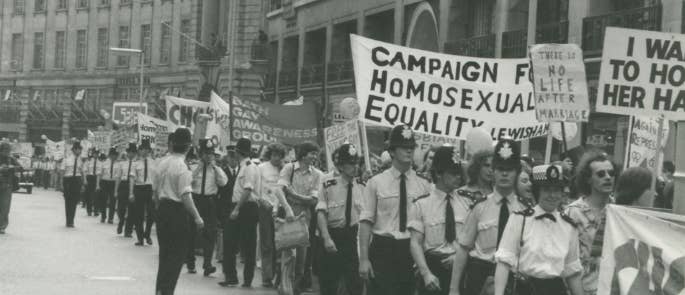
Gay Pride March 1974


The rights of LGBTQ+ people in the world have come a long way in the last hundred years, but they didn’t come easy. It took the sacrifices of so many people who stood up for theirs and others’ freedom to simply be who they are.

We’ve gone from homosexuality being punishable by imprisonment or death, banned from being taught in schools, and diagnosed as a mental illness, to being celebrated in Pride parades and given equal marriage and adoption rights. Meanwhile, trans people finally have the right to legally change their identity and have started to be celebrated in their own dedicated Pride events.

Whether you’re a friend, relative, colleague, or someone who works directly with LGBTQ+ people , it’s important to recognize how hard LGBTQ+ people and their Allies have fought to get where they are today, as well as how hard they continuously work. Despite great strides forward in equality, LGBT oppression is still widespread.

Knowing about LGBT history will give you a better awareness of why LGBTQ+ people need their voices heard and the support of everyone around them. It’ll help us understand why and how we should all help to make the world a more inclusive, accepting place. We can also find out how equality and diversity can benefit our workplace.

People who identify as LGBTQ+ have struggled with oppression for centuries. In fact, one infamous anti-homosexuality law was created during the reign of Henry VIII in the 1500s, known as the ‘Buggery Act’.

The Act outlawed homosexuality making it punishable by death. Fortunately, the last legal executions were in 1835, but homosexuality wasn’t decriminalised until as recently as 1967 – and this was only partially.It’s been an uphill battle for LGBTQ+ rights over the last century. However, despite extreme oppression and discrimination, hundreds of thousands of LGBT historical figures have pushed hard for their and others’ freedom. Several important events in LGBT history have made slow but sure progress towards a better future.

Have a look at the following LGBTQ+ history facts and timeline:

1951: The first known case of sex reassignment surgery. Roberta Cowell, a trans woman, underwent reassignment surgery. She was assigned male at birth, but later had her sex legally changed to female and underwent vaginoplasty surgery.

1964: The formation of the North Western Homosexual Law Reform Committee This group worked to promote legal and social equality .

1966: The formation of the Beaumont Society. This trans-support group aimed to provide better information and awareness about transgender people and act as a self-help and social organisation for them.

1967: The Sexual Offenses Act decriminalizes sex between two men over 21 ‘in private’. However, homosexuality was still widely discriminated and the Act still lead to arrests at that time.

1969: The Stonewall riots occurred. This was one of the most significant events in LGBT history. Riots by LGBTQ+ people were sparked after police raided the Stonewall now a National Historic Landmark, a famous gay bar in New York City. Activists groups, including the Gay Liberation Front (GLF) formed as a result and the Stonewall riots are now remembered as one of the most important catalysts for modern LGBT movements worldwide.

1970: The establishment of the London Gay Liberation Front. This freedom movement was formed after seeing the effects of GLF in the US. They sought to take their own actions for LGBTQ+ rights.

1972: The GLF host the first London Pride event on the anniversary of the Stonewall riots. Around 2000 people attended. Pride events now see millions of attendees marching to celebrate the LGBTQ+ community around the world.

1978: Gilbert Baker artist and gay rights activist, designs the Pride flag. It originally had eight colours, but two were dropped to make mass-production easier. It is now a widely-recognised symbol of LGBTQ+.

1979: The Harry Benjamin International Gender Dysphoria Association is founded. The group’s aim was effective understanding and treatment of gender dysphoria.

1985: Men who have sex with men (MSM) banned from donating blood. A lifetime ban was enacted due to fears amid the HIV/AIDS crisis of the ‘80s. The ban was not lifted until 2011.

1988: The introduction of Section 28 of the Local Government Act. This was a major step backwards for the promotion of LGBTQ+ rights and awareness, triggering a huge uproar and renewed momentum in LGBTQ+ activism.

1988: The formation of Stonewall UK which is now the largest LGBT organisation in Europe. It was founded by Sir Ian McKellen, Lisa Power MBE, and Lord Cashman CBE in response to Section 28 and to campaign for LGBT rights.

1990: LGBT rights group Outrage formed. In response to the murder of five gay men, a candlelit vigil was held in London and the group OutRage was created as a result. They campaigned against police mistreatment of LGBT people, as well as for other political actions.

1992: The World Health Organisation declassifies homosexuality as a mental illness. This was a huge step forward, as LGBTQ+ people had previously received controversial and often detrimental treatments to try and ‘cure’ their sexuality.

1994: The age of consent for same-sex relations between men is lowered to 18. It wasn’t until 2001 that it was lowered to 16 to be equal to the heterosexual age of consent.

1995: The formation of the trans children support group Mermaids . Their aim was and still is to offer support and guidance to trans and gender-diverse children, young people, and their families. They also work to educate and spread awareness in society.

Viswasruti thumbnail
Posted: 4 years ago

As you can see, there have been so many important events in the timeline of LGBT history that were turning points for greater equality and freedom.

A few more historical events while gaining LGBTQ+ rights!

2000-2010: The new millennium and its first decade saw huge steps forward for LGBTQ+ rights. In the year 2000, the ban on lesbian, gay, and bisexual people serving in the army was lifted by UK Government. In 2002, same sex couples in the UK received equal rights for adoption as straight couples. Section 28 was repealed in 2003 in England, Wales, and Northern Ireland. In 2004, the Gender Recognition Act passed, which allows transgender people to fully and legally identify with their chosen gender, as well as acquire a new birth certificate.

2011: The lifetime ban on MSM from donating blood is lifted in the UK However, a 1-year ban was put in place instead, meaning they could not donate blood if they had been sexually active in the last 12 months.

2013: Stonewall UK launches ‘Gay. Let’s get over it’ campaign in schools. Its aim is to address homophobic language and homophobia as a whole.

2013: The first Trans Pride event happens in Brighton. Around 450 people took part and it was said to be the first of its kind in Europe. London’s first Trans Pride march occurred in 2019 and saw more than 1,500 attendees.

2014: The Marriage (Same-Sex Couples) Act comes into effect in England and Wales, finally making same-sex marriage legal. Scotland followed suit later in the same year.

2017: The Children and Social Work Bill is amended, making relationships and sex education (RSE) mandatory in all schools in England and Wales as of 2019.

2017: The 1-year ban on MSM for donating blood is changed to 3 months. Northern Ireland still has the 1-year ban in place.

2019: The World Health Organisation declassifies transgender health issues as a mental illness. Graeme Reid (LGBT rights director at Human Rights Watch) said the changes would have a “liberating effect on transgender people worldwide”.

Same-sex marriage legalised in Northern Ireland. The first marriage ceremony occurred on 11th February 2020.

Same-sex relationships are finally legally permitted and their rights as couples to marriage and adoption are finally equal to their straight counterparts. Health organisations no longer stigmatise homosexuality or transgender issues with dated definitions, and Pride events across the country give LGBTQ+ people a place to feel included, heard, and valued.

Our awareness of what LGBTQ+ people have gone through and continue to experience and being supportive of LGBTQ+ rights is one of the most effective ways to help make LGBT oppression history.

They are not different, they are an important part of the society, let us respect their needs and understand their pain.

Related Topics

Fan Fictions thumbnail

Posted by: sarveshjoshi42 · 6 months ago

Characters Burak Ozçivit : Osman Bey Ozge Torer : Bala Hatun Yiğit Uçan as Boran Alp Ragıp Savaş as Dündar Bey Eren Vurdem as Konur Alp Alma...

Expand ▼
Fan Fictions thumbnail

Posted by: jasminerahul · 1 months ago

Tere Pyaar Mein..In your love...Part 1 I dedicate this SS to my dearest friend Shesha who asked me to write a story on the hindi movie Akaash...

Expand ▼
Fan Fictions thumbnail

Posted by: sarveshjoshi42 · 9 years ago

Here are Characters of the Story Ritik : elder brother of Shivaay , Ranveer , Sanskar and love interest of Shivanya Shivanya : elder sister of

Expand ▼
Fan Fictions thumbnail

Posted by: sarveshjoshi42 · 8 years ago

Ritik Mehra : Business Tycoon and Elder brother of Raghav Shivanya Kapoor : Doctor and Elder Sister of Naina and love interest of Ritik

Expand ▼
Fan Fictions thumbnail

Posted by: sarveshjoshi42 · 9 years ago

Let's me introduced the Characters Ritik Raheja (Arjun Bijlani) : A very rich business tycoon and elder brother of Ranveer and Ragini Ranveer

Expand ▼
Top

Stay Connected with IndiaForums!

Be the first to know about the latest news, updates, and exclusive content.

Add to Home Screen!

Install this web app on your iPhone for the best experience. It's easy, just tap and then "Add to Home Screen".